
On the surface, sport appears to be a celebration of the human body, a contest of strength, speed, skill, and nerve. Yet beneath every spectacular goal, every record-breaking sprint, and every perfectly timed serve lies a vast and hidden world of numbers. Sport is, in truth, mathematics in motion. The angle of a shot, the curve of a pass, the pace of a runner, and the strategy of an entire team can all be described, analyzed, and understood through the language of mathematics. To see sport this way is to discover a new dimension of its beauty, and it is exactly this kind of insight that the United Kingdom Mathematics Trust seeks to nurture, showing young people that the mathematics they learn in the classroom is alive in the games and competitions they love.


Where Sport Meets Numbers
The connection between sport and mathematics is older than most people imagine. The ancient Greeks, who gave us the Olympic Games, were also among the first to study mathematics seriously, and they saw no contradiction between the two. To them, the measured distances of a running track, the geometry of a wrestling ground, and the timing of a race were all expressions of the same rational order they sought to understand through number and shape. Modern sport has only deepened this relationship, becoming one of the richest and most visible arenas in which mathematics is applied.
Today, mathematics is woven into sport at every level. It governs the design of equipment and the layout of playing fields. It shapes the training regimes of elite athletes and the tactics of professional teams. It drives the multi-billion-pound industry of sports analytics, where armies of mathematicians and data scientists search for the tiny advantages that separate victory from defeat. Far from being separate worlds, sport and mathematics are partners, each illuminating the other.
This partnership offers a wonderful opportunity in education. Many young people who feel indifferent toward mathematics discover a sudden enthusiasm when they see it at work in a sport they care about. UKMT recognizes this power, and through its problems and resources it invites students to bring their mathematical thinking to bear on the real, dynamic, exciting situations that sport provides.
Geometry on the Pitch: Angles, Space, and Position
Watch a football match with a mathematician eye and the pitch transforms into a living geometry problem. Every pass is a line, every shot an angle, and every player a point whose position relative to others determines the flow of the game. The best players are, without realizing it, superb intuitive geometers, constantly judging distances, estimating angles, and reading the spatial relationships that decide whether an attack will succeed or fail.

Consider the striker bearing down on goal. The angle from which a shot is taken determines how much of the goal is open and how difficult it will be for the goalkeeper to save. A shot from directly in front presents a wide angle and a high chance of scoring, while a shot from a sharp angle near the sideline offers only a sliver of open goal. This is pure geometry, the relationship between a point and a line segment, and elite players develop an instinctive feel for it. Defenders, meanwhile, use geometry to cut off passing lanes and reduce the angles available to their opponents.
The spatial organization of a whole team is also a geometric matter. Modern tactics speak of compact shapes, of triangles formed between players, and of the distances that must be maintained between lines of defense, midfield, and attack. A team that controls space controls the game, and controlling space is, at its core, an exercise in geometry. This is precisely the kind of structural thinking that UKMT challenges cultivate, training students to see and manipulate shape, position, and relationship.
The Arc of a Shot: Parabolas and Projectiles
When a basketball player releases a shot, the ball does not travel in a straight line. It rises, slows, and falls in a graceful curve known as a parabola, one of the most famous shapes in mathematics. This curve is not a matter of chance. It is the inevitable result of gravity acting on a moving object, and it can be predicted with perfect precision using the equations of projectile motion. Every free throw, every jump shot, and every three-pointer is a parabola in flight.

The mathematics of the parabola reveals a surprising truth about shooting. The angle at which the ball is launched matters enormously. A shot released at too flat an angle presents a small target, the oval of the hoop seen edge-on, and is easily blocked or missed. A higher arc presents the ball with a larger effective target as it descends toward the hoop. Analysis shows that an optimal launch angle exists, balancing the height of the arc against the force and control required to achieve it. The greatest shooters in the world have, through countless hours of practice, trained their bodies to reproduce this optimal mathematics with extraordinary consistency.
Here is a beautiful example of how abstract mathematics connects to physical excellence. The equations that students learn when studying curves and motion are the very equations that govern the flight of a ball. Recognizing this connection brings the curriculum to life, and it is one of the great joys that mathematical thinking can offer.
Speed, Distance, and Time: The Arithmetic of Movement
At the heart of nearly every sport lie three simple quantities: speed, distance, and time. The relationship between them, expressed in the deceptively simple formula that speed equals distance divided by time, is the foundation of all movement and the starting point of the mathematics of motion. From the sprinter exploding from the blocks to the cyclist climbing a mountain pass, every athletic performance is, at its core, a problem of covering a distance in the least possible time.

Yet the simplicity of this relationship conceals a world of complexity. In a cycling time trial, for instance, a rider must decide how to distribute effort across the course. Push too hard too early and exhaustion will force a slowdown later; conserve too much and precious time is lost. The optimal strategy, known in mathematics as a problem of optimization, depends on the terrain, the wind, and the physiology of the rider, and solving it requires sophisticated calculation. Professional teams now use mathematical models to advise their riders on exactly how much power to produce at every moment of a race.
This is the mathematics of rates and change, the gateway to the deeper study of how quantities evolve over time. When students grapple with problems involving speed, acceleration, and changing rates, they are developing the same reasoning that helps elite athletes and their coaches shave seconds from a performance. It is mathematics with immediate, visible, thrilling consequences.
The Curve of a Champion: Measuring Improvement
In sport, improvement is everything, and improvement is measured in numbers. The athlete who runs a hundred meters in 10.2 seconds dreams of reaching 10.0, and eventually of breaking the magic barrier of 10 seconds flat. These tiny improvements, fractions of a second that mean almost nothing in everyday life, represent the difference between obscurity and legend in the world of elite sport. Measuring, tracking, and interpreting such improvements is a fundamentally mathematical task.

Coaches rely on graphs and statistics to monitor an athlete development over time. A single fast run might be a fluke, but a consistent trend of improvement tells a deeper story. Distinguishing genuine progress from random variation requires an understanding of averages, of spread, and of the patterns hidden within data. Is the athlete truly getting faster, or is today simply a good day? Answering this question well is an exercise in statistical reasoning.
This same reasoning lies at the heart of mathematics education. Learning to interpret data, to recognize trends, and to separate signal from noise are among the most valuable skills a student can acquire, useful far beyond the classroom and the sports field alike. UKMT problems frequently ask students to reason carefully about numbers and patterns, building exactly this disciplined, analytical habit of mind.
Spin, Trajectory, and the Physics of the Ball
Few sights in sport are as mesmerizing as a tennis ball curving through the air or dipping suddenly over the net. These magical movements are the work of spin, and spin is governed by mathematics and physics working hand in hand. When a player strikes a tennis ball with topspin, the rotating ball drags the air around it, creating a difference in pressure that pushes the ball downward in a steeper curve than gravity alone would produce. The result is a shot that clears the net yet plunges sharply into the court.
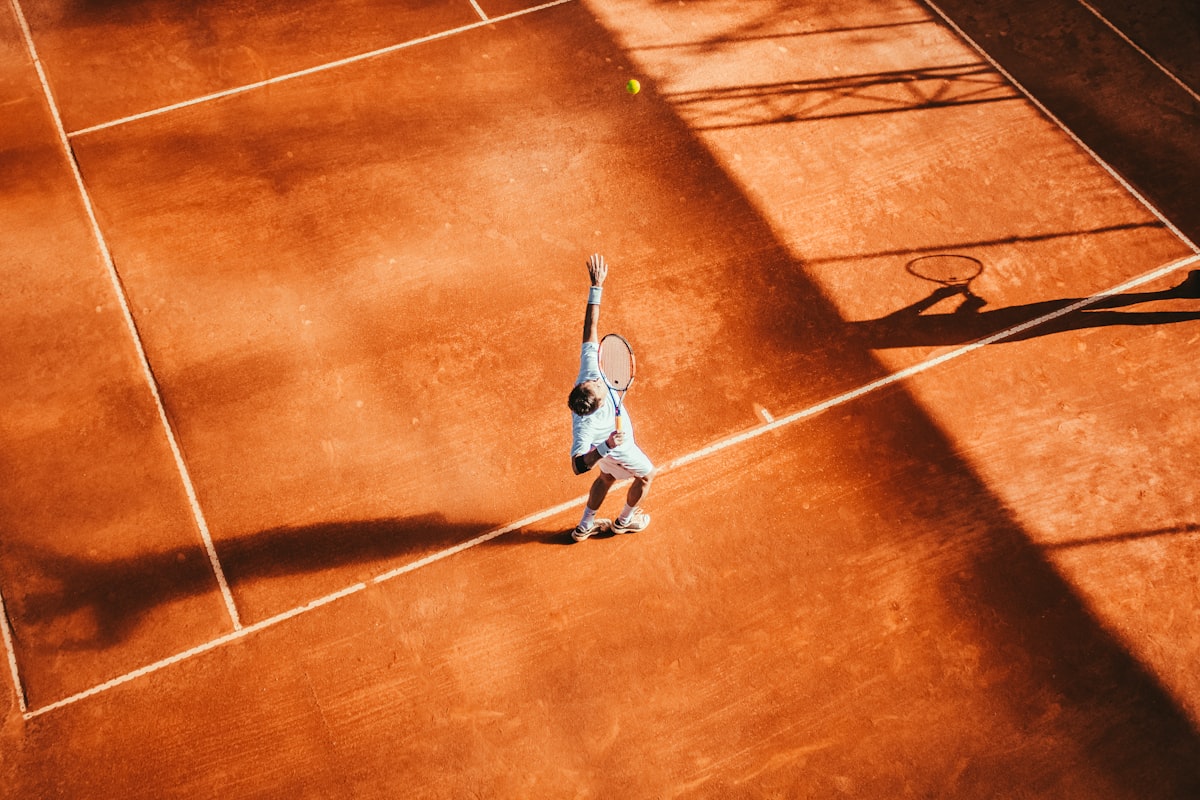
This phenomenon, known as the Magnus effect, can be described precisely using the mathematics of fluid flow and forces. The amount of curve depends on the rate of spin, the speed of the ball, and the properties of the air, and understanding these relationships allows players to control the flight of the ball with astonishing accuracy. The same effect explains the swerve of a football, the drift of a cricket ball, and the break of a baseball pitch.
For a student, this is mathematics at its most powerful and elegant. A single principle, expressed in equations, explains a whole family of seemingly different phenomena across many sports. Discovering such unifying principles is one of the supreme rewards of mathematical thinking, and it is a reward that UKMT encourages students to pursue.
Fluid Dynamics and the Science of Speed
In the water, the mathematics of sport takes on a new and fascinating form. A swimmer moving through a pool must battle against the resistance of the water, a force that grows rapidly with speed and that depends on the shape and position of the body. Reducing this resistance, known as drag, is one of the central challenges of competitive swimming, and it is a challenge that can only be met through mathematics.

The drag force on a body moving through a fluid is described by an equation involving the density of the fluid, the speed of motion, and a quantity called the drag coefficient, which depends on shape. Because drag increases with the square of speed, doubling one pace requires roughly four times the effort to overcome resistance. This single mathematical fact has enormous consequences. It explains why tiny improvements in body position, by lowering the drag coefficient, can produce significant gains in speed, and why elite swimmers obsess over the smoothness of their streamline.
Fluid dynamics is one of the most mathematically demanding branches of physics, yet its principles are visible every time a swimmer glides through the water. It is a vivid reminder that the most abstract mathematics can have the most concrete and dramatic effects, a lesson that lies close to the spirit of UKMT, which seeks to reveal the hidden power of mathematical ideas.
Data and Analytics: The Numbers Revolution in Sport
Perhaps the most dramatic meeting of sport and mathematics in recent years has been the rise of data analytics. Modern professional sport generates an ocean of numbers: the position of every player at every moment, the speed and spin of every ball, the distance covered by every athlete. Transforming this flood of data into insight has become one of the most important and best-paid applications of mathematics in the world.
Famous examples abound. Teams that once relied on the instincts of experienced managers now employ teams of analysts who use statistical models to identify undervalued players, to predict the outcomes of different tactics, and to find the marginal gains that decide championships. Decisions that were once matters of gut feeling are now informed by probability, by optimization, and by the careful interpretation of data. Mathematics has, quite literally, changed the way sport is played and won.
For young people, this revolution sends an inspiring message. The mathematics studied in school is not an academic exercise with no bearing on the real world. It is, in fact, one of the most sought-after skills in one of the most exciting industries on earth. UKMT, by developing strong analytical and problem-solving abilities, helps prepare students to thrive in precisely this data-driven future, whether their passions lie in sport, science, business, or beyond.
Probability and the Unpredictable Magic of Competition
For all the mathematics that governs sport, there remains an element that no equation can fully tame: uncertainty. Sport captivates us precisely because its outcomes are never certain. The underdog can win, the favorite can fall, and a single moment of brilliance or error can decide a contest. This irreducible unpredictability is the domain of probability, the mathematics of chance, and understanding it deepens rather than diminishes the drama of sport.
A skilled penalty taker might score eight times out of ten, yet on any given attempt the outcome remains uncertain. A tennis player might be the clear favorite to win a match, yet the mathematics of probability reminds us that over a long contest there is always a meaningful chance of an upset. Appreciating these probabilities allows us to understand why upsets happen, why streaks occur, and why even the best in the world cannot win every time. It teaches us to think clearly about luck and skill, about what can be controlled and what cannot.
This is one of the most practically valuable lessons mathematics has to offer. In a world full of uncertainty, the ability to reason probabilistically, to weigh evidence, and to make sound judgments under conditions of incomplete information is indispensable. Problems that invite students to think about chance and likelihood are a staple of the UKMT approach, building a skill that serves them throughout their lives.
The Mathematical Athlete
To look at sport through the lens of mathematics is to see it anew. The flying ball becomes a parabola, the flowing swimmer a lesson in fluid dynamics, the tactics of a team an exercise in geometry, and the unfolding drama of a season a study in probability. None of this reduces the beauty of sport. On the contrary, it reveals a deeper beauty hidden beneath the surface, the beauty of a universe that runs on mathematical laws and that rewards those who take the trouble to understand them.
This is the vision that animates the United Kingdom Mathematics Trust. Mathematics is far more than a subject to be examined and forgotten. It is a way of seeing the world, a tool for understanding everything from the flight of a football to the strategies that win championships. By helping young people discover the numbers hidden within the sports they love, UKMT opens a door onto a lifetime of curiosity, insight, and wonder. The game is full of mathematics. All that is needed is the desire to see it, and the mind to understand what it reveals.