
UKMT Alumni: From Mathematics Competitions to Distinguished Careers Around the World

The United Kingdom Mathematics Trust (UKMT) has been nurturing mathematical talent for decades, but its impact extends far beyond competition results and medal counts. The young people who participate in UKMT's challenges, olympiads, and enrichment programmes go on to lead remarkable lives, shaping industries, advancing research, and driving innovation across the globe. This article explores the career trajectories of UKMT alumni and the lasting value of mathematical excellence in the modern world.

Graduation ceremony celebrating academic achievement

From mathematics competitions to graduation ceremonies: UKMT alumni excel at every stage of their educational journey

推荐

The Pipeline from Competition to Career

The path from UKMT competitions to professional success is well-established. Many of today's leading mathematicians, scientists, engineers, and business leaders first discovered their passion for mathematics through UKMT's programmes. The skills they developed — logical reasoning, creative problem-solving, rigorous analysis, and the ability to communicate complex ideas — have proven invaluable across every field of human endeavour.

What makes UKMT alumni particularly successful is not merely their mathematical knowledge but their approach to challenges. They have learned to tackle unfamiliar problems with confidence, to persist through difficulty, and to find elegant solutions where others see only complexity. These qualities are prized in any profession, from finance to technology, from academia to entrepreneurship.

Modern technology workspace where analytical skills are essential

The modern workplace demands precisely the skills that UKMT cultivates: analytical thinking, problem-solving, and innovation

Academia and Research: Pushing the Boundaries of Knowledge

Many UKMT alumni pursue careers in academia, contributing to the advancement of mathematical knowledge and training the next generation of mathematicians. They can be found at leading universities across the United Kingdom and around the world — Cambridge, Oxford, Imperial College London, MIT, Stanford, and Princeton all count UKMT alumni among their faculty.

Some have gone on to win the most prestigious awards in mathematics. The Fields Medal, often described as the Nobel Prize of mathematics, has been awarded to several British mathematicians who participated in UKMT competitions during their school years. These individuals have made groundbreaking contributions to areas such as number theory, algebraic geometry, and mathematical physics, shaping the direction of entire fields.

Scientific research laboratory where mathematical thinking drives discovery

Mathematical research: where UKMT alumni push the boundaries of human knowledge

Beyond pure mathematics, UKMT alumni have made significant contributions to applied mathematics, computer science, physics, and other scientific disciplines. Their ability to think rigorously and creatively has led to advances in areas ranging from cryptography and coding theory to climate modelling and quantum computing. The UK IMO teams of past decades have produced many of today's leading researchers, demonstrating the long-term value of early mathematical enrichment.

Technology and Innovation: Building the Digital Future

The technology sector has proven to be a natural home for many UKMT alumni. The analytical skills, logical reasoning, and problem-solving abilities developed through mathematical competitions translate directly to the challenges of software engineering, artificial intelligence, data science, and cybersecurity.

Startup team collaborating on innovative technology solutions

Innovation and entrepreneurship: UKMT alumni bringing mathematical thinking to technology startups

Major technology companies including Google, Microsoft, Amazon, and Meta actively recruit candidates with strong mathematical backgrounds. UKMT alumni are well-represented in these organizations, working on projects that range from machine learning algorithms to distributed systems, from search engine optimization to virtual reality. Their ability to approach complex technical challenges with mathematical rigour gives them a distinct advantage in these competitive fields.

Many UKMT alumni have also founded their own technology companies, applying the creative problem-solving skills they developed through mathematics competitions to build innovative products and services. The entrepreneurial mindset — the ability to see opportunities where others see obstacles, to persist through failure, and to find elegant solutions to complex problems — is precisely what UKMT competitions cultivate.

Finance and Quantitative Analysis: The Mathematics of Markets

The finance industry has long recognized the value of mathematical talent, and UKMT alumni are highly sought after by investment banks, hedge funds, and trading firms. The ability to analyze complex data, identify patterns, and make decisions under uncertainty — all skills honed through mathematical competitions — are essential in quantitative finance.

Data analysis and financial modelling in modern business

Quantitative finance: where mathematical thinking meets real-world markets

Roles such as quantitative analyst, risk manager, and algorithmic trader require precisely the kind of mathematical thinking that UKMT develops. The ability to construct and test hypotheses, to work with probability and statistics, and to communicate complex findings clearly are all directly applicable to success in finance. Many UKMT alumni have risen to senior positions in major financial institutions, bringing mathematical rigour to decision-making at the highest levels.

Medicine, Law, and Public Policy: Mathematics Beyond Numbers

Perhaps surprisingly, the skills developed through UKMT competitions are valuable in fields that might seem far removed from mathematics. Medicine, law, public policy, and many other professions benefit enormously from the analytical thinking and logical reasoning that mathematical training provides.

Professional office environment where analytical skills drive success

Professional excellence: the analytical skills developed through mathematics apply across all career paths

In medicine, the ability to analyze complex symptoms, weigh evidence, and make decisions under pressure mirrors the problem-solving process in mathematical competitions. Many UKMT alumni have become leading physicians, medical researchers, and public health experts, applying their mathematical training to improve patient outcomes and advance medical knowledge.

The legal profession similarly values the ability to construct clear, logical arguments and to analyze complex information — skills that olympiad-level mathematics develops intensively. UKMT alumni can be found in leading law firms, judicial positions, and legal academia, bringing the same rigour and precision to legal reasoning that they once applied to mathematical proofs.

推荐

Entrepreneurship and Leadership: Building Organizations

The combination of analytical thinking, creative problem-solving, and resilience developed through UKMT participation creates ideal conditions for entrepreneurial success. Many alumni have founded companies, led organizations, and created initiatives that have had significant impact in their fields.

Business meeting demonstrating leadership and strategic thinking

Leadership and strategy: UKMT alumni bringing mathematical thinking to organizational challenges

The ability to see patterns in complex data, to model different scenarios and their outcomes, and to communicate ideas persuasively are all crucial for effective leadership. UKMT alumni often find themselves in positions where they must make strategic decisions, manage teams, and navigate uncertainty — situations where their mathematical training provides a valuable framework for thinking.

The UKMT Community: A Network for Life

Beyond individual career success, UKMT participation creates a community that endures throughout life. Alumni often maintain connections with fellow competitors, mentors, and volunteers, forming a network of support and opportunity. These connections can lead to collaborations, job opportunities, and lifelong friendships.

Academic research and publication in mathematics

Academic collaboration: the UKMT community extends throughout careers in research and beyond

Many successful professionals give back to UKMT as volunteers, mentors, or donors, ensuring that the next generation has the same opportunities they once had. This cycle of giving back strengthens the mathematical community and ensures that UKMT's mission continues to flourish.

Recognition and Achievement

UKMT alumni have received numerous prestigious awards and honours throughout their careers. Beyond the Fields Medal, alumni have been elected to the Royal Society, appointed as professors at leading universities, and recognized with knighthoods and other national honours for their contributions to mathematics and society.

In industry, UKMT alumni have been recognized with technical awards, innovation prizes, and leadership accolades. Their ability to apply mathematical thinking to real-world problems has led to patents, publications, and products that have improved lives around the world.

The recognition that UKMT alumni receive is not merely a reflection of individual talent but a testament to the effectiveness of the UKMT approach to mathematical education. By focusing on problem-solving, creativity, and perseverance rather than rote learning, UKMT prepares young people not just for examinations but for the challenges of a rapidly changing world.

Inspiring the Next Generation

Perhaps the most important legacy of UKMT alumni is their role in inspiring the next generation. Many alumni return to their schools as guest speakers, volunteer as mentors, or simply share their stories with young people who are just beginning their mathematical journey.

When a current UKMT participant learns that someone who once sat the same competitions has gone on to win a Fields Medal, lead a major technology company, or make groundbreaking medical discoveries, it transforms their sense of what is possible. The achievements of alumni demonstrate that mathematical talent, properly nurtured, can lead to extraordinary outcomes.

Mentoring and inspiring the next generation

Passing the torch: UKMT alumni inspiring the next generation of mathematical thinkers

Mathematics opens doors to extraordinary careers.
Join the community of UKMT alumni shaping the future.
www.ukmt.org.uk

推荐

UKMT and Life Skills: How Mathematical Competitions Develop Abilities Beyond Mathematics

Mathematics education has long been valued for its ability to develop logical thinking and problem-solving abilities. But the United Kingdom Mathematics Trust (UKMT) offers something far more comprehensive than mere calculation skills. Through its carefully designed competitions, mentoring programmes, and enrichment activities, UKMT cultivates a suite of life skills that serve young people well beyond the mathematics classroom. This article explores how participation in UKMT activities develops resilience, communication, collaboration, creativity, and confidence — abilities that are essential for success in any field.

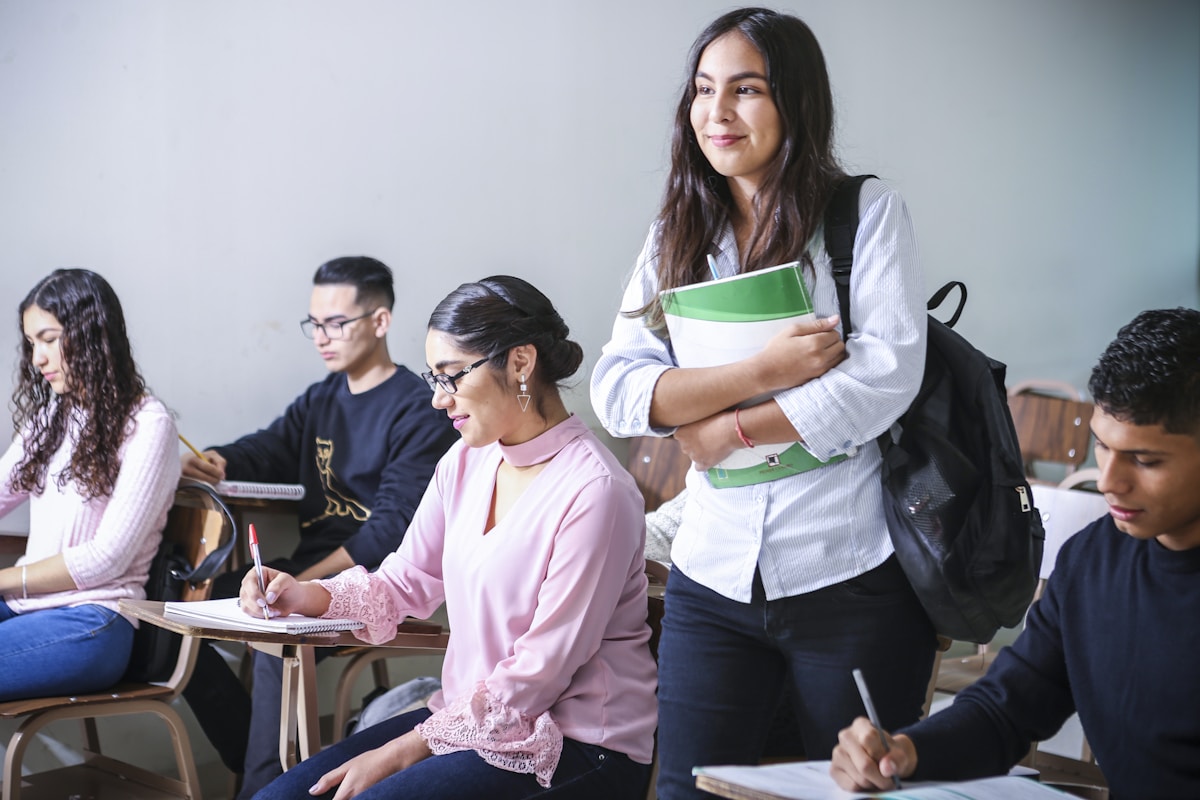
Students developing problem-solving and critical thinking skills

Mathematical challenges develop far more than mathematical knowledge — they build the foundation for lifelong success

推荐

Resilience: Learning to Embrace Challenge

In a world that often prioritizes immediate success and quick answers, UKMT competitions teach young people the value of productive struggle. The challenges are deliberately designed so that even the strongest mathematicians cannot complete every question within the time limit. This reality forces students to confront difficulty, manage frustration, and persist in the face of obstacles.

When a student encounters a problem they cannot immediately solve, they must decide whether to move on or continue working. This decision-making process builds resilience — the ability to tolerate discomfort and maintain effort despite setbacks. Students learn that struggle is not a sign of failure but a necessary part of learning and growth.

Student demonstrating confidence after overcoming mathematical challenges

Confidence comes not from easy success but from overcoming genuine challenges

The mentoring scheme provides an extended opportunity to develop this resilience over time. Over the course of an academic year, students work through eight increasingly challenging problem sets. Each month brings new difficulties, and students must learn to persevere through confusion and uncertainty. The relationship with their mentor provides support and encouragement, but the student must ultimately find their own path through each problem.

Communication: Articulating Complex Ideas

Mathematical communication is a skill that extends far beyond the subject itself. In olympiad-level competitions such as the British Mathematical Olympiad, students must not only solve problems but explain their reasoning clearly and persuasively. A correct answer without proper justification earns few marks — students must demonstrate their understanding through rigorous written argument.

This requirement develops the ability to organize thoughts logically, present ideas in a structured way, and anticipate potential questions or objections. These are precisely the skills needed in academic writing, professional reports, legal arguments, and any context where clear communication is essential.

Students collaborating and communicating mathematical ideas

Collaborative problem-solving develops communication skills that transfer to every area of life

The Team Maths Challenge provides particularly rich opportunities for communication development. In the Relay round, team members must communicate their answers clearly and accurately to avoid cascading errors. In the Group round, students must discuss, debate, and ultimately reach consensus on solutions. These experiences teach young people to listen actively, express ideas respectfully, and build on others' contributions — skills that are essential in any collaborative endeavor.

Collaboration: Working Effectively with Others

While mathematics is often perceived as a solitary pursuit, UKMT's team competitions demonstrate that mathematical thinking thrives in collaboration. The Team Maths Challenge and Senior Team Maths Challenge require groups of four students to work together, combining their individual strengths to solve problems that none could tackle alone.

Team meeting and strategic planning

Strategic thinking and collaboration: essential skills developed through team mathematics competitions

Successful teams learn to recognize each member's strengths and allocate tasks accordingly. Some students excel at geometry, others at number theory or combinatorics. The art of building a strong team lies not in selecting the four best individual mathematicians but in choosing four people who work well together and bring complementary skills.

These experiences mirror the realities of professional life, where projects require diverse expertise and effective teamwork. Students who participate in UKMT team competitions develop an understanding of group dynamics, learn to navigate different working styles, and gain experience in both leading and supporting — all crucial skills for future careers.

Creativity: Finding Novel Approaches

Mathematical creativity is the ability to see patterns, make unexpected connections, and find elegant solutions to complex problems. UKMT competitions reward creative thinking by presenting problems that cannot be solved through routine application of formulas or algorithms.

Student engaged in creative problem-solving

Creative mathematical thinking: finding elegant solutions to problems that have no obvious approach

Students quickly learn that the most direct approach is not always the best. A problem that seems impossible through one method may become straightforward when viewed from a different angle. This flexibility of thinking — the ability to shift perspectives and try multiple approaches — is a hallmark of creative problem-solvers.

The mentoring scheme particularly encourages creativity by exposing students to problems that require sustained exploration. Without time pressure, students can experiment with different methods, follow false leads, and ultimately discover the satisfaction of finding an elegant solution. This process mirrors the creative process in art, music, writing, and scientific research — all fields where persistence and imagination combine to produce breakthroughs.

推荐

Confidence: Believing in One's Abilities

Success in mathematics builds confidence, but so does learning to handle failure constructively. UKMT competitions provide a balanced experience of both. Students who excel gain recognition through certificates and invitations to follow-on rounds. Those who struggle learn that difficulty is normal and that improvement comes through practice and perseverance.

Student receiving recognition for mathematical achievement

Recognition and achievement: building confidence through genuine mathematical accomplishment

The progressive structure of UKMT competitions allows students to build confidence gradually. A student might begin with the Junior Mathematical Challenge, find the experience enjoyable despite not completing all questions, and return the following year with greater skill and assurance. This incremental approach prevents the overwhelming pressure that can come from facing challenges too far beyond one's current ability.

The National Mathematics Summer School provides a particularly powerful confidence-building experience. Students spend a week surrounded by peers who share their passion for mathematics, working alongside volunteers and mentors who model enthusiasm and expertise. Many students return from summer school transformed — no longer seeing themselves as isolated "maths people" but as part of a vibrant community of young mathematicians.

Time Management and Strategic Thinking

UKMT competitions require students to make strategic decisions about how to allocate their time. With limited minutes and varying question difficulties, students must quickly assess which problems to attempt and which to leave for later. This develops time management skills and the ability to work effectively under pressure.

These skills transfer directly to examination situations, where students must balance thoroughness with efficiency. More broadly, they prepare young people for the demands of higher education and professional life, where juggling multiple tasks and meeting deadlines are everyday realities.

Young woman demonstrating strategic thinking and confidence

Strategic thinking and time management: skills developed through competition that serve for life

Growth Mindset: The Belief That Ability Develops Through Effort

Perhaps the most significant life skill developed through UKMT participation is a growth mindset — the belief that mathematical ability is not fixed but develops through practice, persistence, and learning from mistakes. This mindset has profound implications for how young people approach challenges in all areas of life.

When students receive feedback on their olympiad solutions, they learn that improvement comes not from innate talent but from careful analysis of errors and deliberate practice. When they progress through the mentoring scheme, they see firsthand how their problem-solving abilities have developed over months of sustained effort. These experiences instill the understanding that growth is possible through dedication — a belief that serves them throughout their education and careers.

Books and learning resources for continuous development

Continuous learning and development: the growth mindset that UKMT cultivates in young mathematicians

Social Skills and Community Building

UKMT competitions and events create opportunities for young people to connect with peers who share their interests. The National Mathematics Summer School, regional heats of team competitions, and olympiad training events bring together students from diverse backgrounds and schools across the country.

These experiences help students develop social skills in an academic context. They learn to articulate their interests, ask thoughtful questions, and engage in meaningful discussions about ideas. For many students, these events provide their first experience of being part of a community where intellectual curiosity is valued and celebrated.

The friendships formed at UKMT events often endure well beyond the competitions themselves. Students maintain contact through social media, attend university together, and sometimes collaborate professionally in later years. The UKMT community becomes a network of support and connection that extends throughout their lives.

Preparing for Higher Education and Beyond

Universities recognize the value of UKMT participation. Strong performance in UKMT competitions, particularly at olympiad level, demonstrates not only mathematical ability but also the qualities that higher education institutions seek: intellectual curiosity, perseverance, analytical thinking, and the ability to work independently.

Many students include their UKMT achievements in university applications, and admissions tutors view these accomplishments favorably. The skills developed through UKMT participation — particularly the ability to construct clear arguments, work collaboratively, and approach complex problems creatively — align closely with the competencies that universities aim to develop in their students.

Beyond higher education, UKMT alumni can be found in diverse fields including finance, technology, research, medicine, law, and the arts. The problem-solving abilities and work habits developed through mathematical competition serve them well regardless of their chosen career path. Employers value candidates who can think critically, communicate effectively, and tackle unfamiliar challenges with confidence — all qualities that UKMT participation cultivates.

The Long-Term Impact

The true measure of UKMT's success lies not in competition results or medal counts but in the lives of the young people it has influenced. Former participants often recall their UKMT experiences as pivotal moments in their educational journeys — times when they discovered their potential, found a community of like-minded peers, or developed the confidence to pursue ambitious goals.

Teachers report that students who participate in UKMT activities often become more engaged in classroom learning, more willing to tackle challenging problems, and more supportive of their peers' mathematical development. The positive effects ripple outward, influencing school culture and inspiring younger students to engage with mathematics.

Long-term community and lasting impact

The lasting impact: UKMT develops not just mathematicians but confident, creative, resilient young people

As one teacher reflected, the greatest value of UKMT lies in showing students that "mathematics is not just about getting the right answer — it's about the journey of discovery, the satisfaction of overcoming challenges, and the joy of sharing ideas with others." These are lessons that extend far beyond mathematics and remain with students throughout their lives.

Mathematics opens doors. UKMT helps young people walk through them with confidence.
Learn more at www.ukmt.org.uk

推荐

Online Customer Service
Contact Customer Service